Welcome to Your Home Away from Home!

Welcome to Modern Living Komagome

This house manual is designed to help you make the most of your stay while minimizing any stress. Inside, you’ll find everything you need to know about the property, including:

  • How-to Guides: Easy instructions for appliances, Wi-Fi, heating, and more.
  • Local Tips: Recommendations for nearby attractions, dining, and services.
  • House Rules: Guidelines to ensure a safe and pleasant stay for everyone.
  • Emergency Contacts: Quick access to assistance when you need it.

Take a moment to review it, and feel free to reach out if you have questions.
Relax, explore, and enjoy your time ❣

Komagome House Manual

Please turn off the air conditioner when not in the apartment.
It would take only a few minutes for the machine to cool or heat the apartment again. 

Electricity usage is monitored, and excessive use while the apartment is unoccupied has been detected; additional charges may apply.

Thank you for your cooperation!
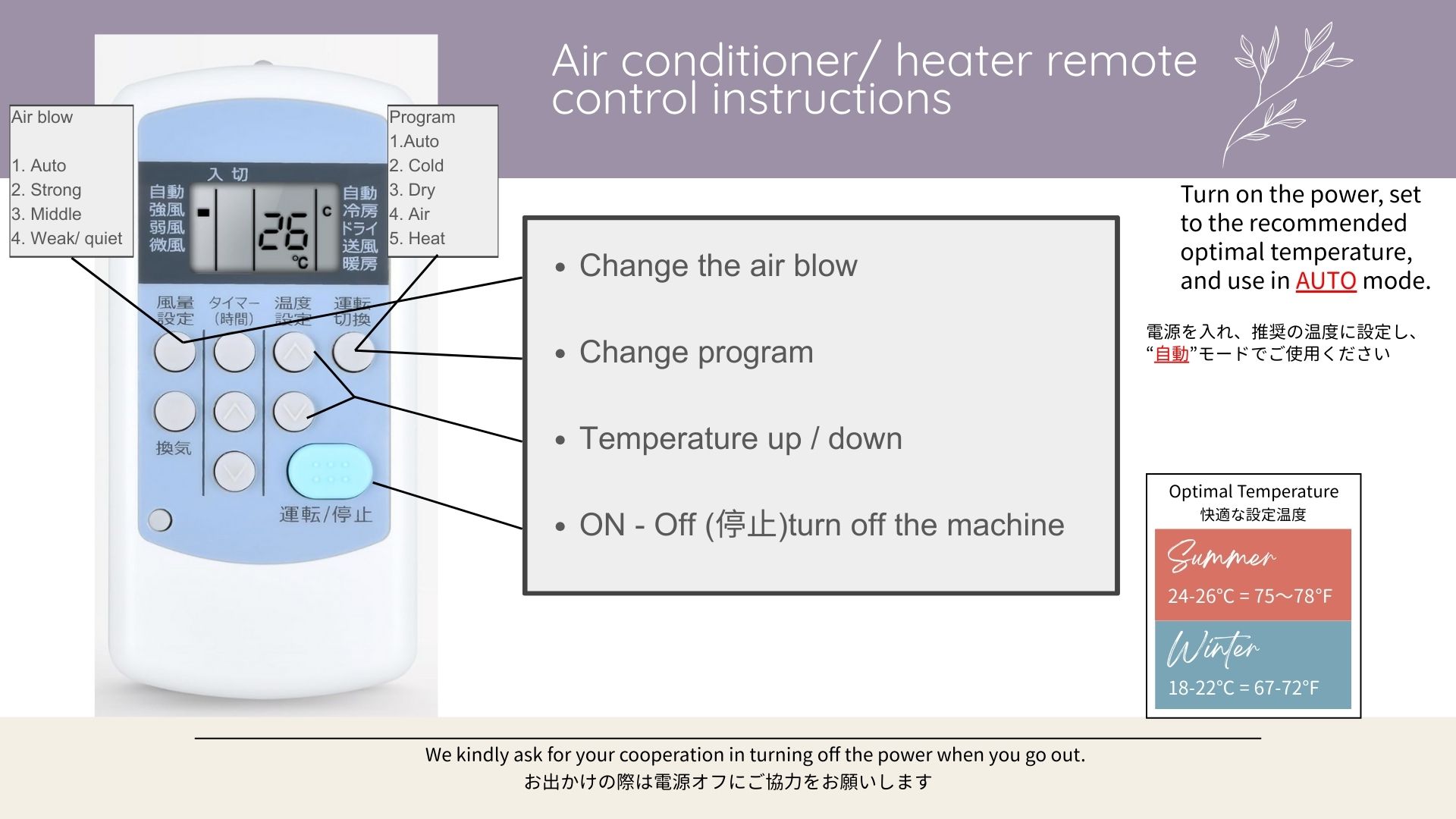
Click to enlarge the photo!

Tips to use the AC in summer and in winter:
To make the best use of an air conditioner in Japan and avoid spending too much energy, it is necessary to know a few key elements related to life in Japan, which we explain below.
Mind the temperature differences!

Don’t run the air conditioner at extremely low temperatures and full air blow; the machine will be noisy. You need a low air blow for this size of the room; it would take only a few minutes to cool and heat.

The temperature variations between the room and the outdoors should not be too high. With a 5°C (9°F) difference, one already feels better, heat or cold-related sickness can be prevented, and the impact on the energy bill is also limited, in a nice ecological move.
It is recommended to set an ideal indoor temperature at 24-25°C in summer and at 25-26°C in winter.
At night, the outdoor temperature naturally lowers, and it is not necessary to overuse the AC. We recommend setting the unit with a lower difference with outdoor temperature than during the daytime, at about 2 to 3°C in summer. Setting down the AC also lessens the noise the fans can make and thus helps ensure a better night for those who are sensitive to the noise.
 
In winter, Japanese people tend to sleep on futons covered by warm blankets or duvets, and the AC in heat mode can be enough when the temperature is set to 18 or 19°C, or even shut down for the less chilly.
 
In summer, I personally set the air conditioner to DRY mode for 25-26 with automatic air blow at nighttime, and COOL mode for 25-26 with small air blow in daytime. 
 

Please turn off the air conditioner when not in the apartment.
It would take only a few minutes for the machine to cool or heat the apartment again. 

Electricity usage is monitored, and excessive use while the apartment is unoccupied has been detected; additional charges may apply.

Thank you for your cooperation!


The general rules for separating garbage are straightforward. 
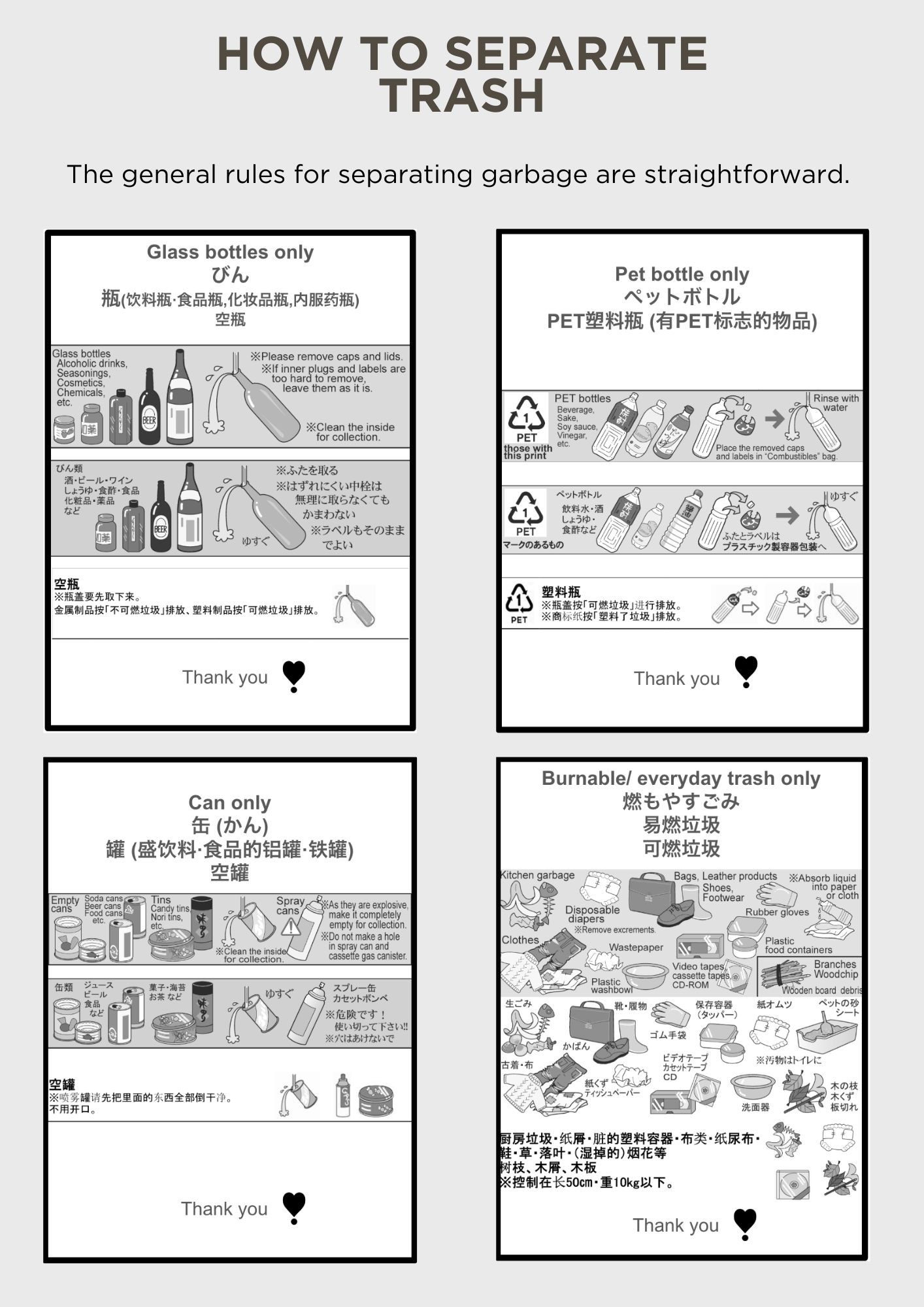
Separate trash 
Please divide the trash into four main categories:
  • Combustible (Burnable)
  • PET bottles (empty ones)
  • Can/ Pin (empty ones)
  • Large-sized garbage
IMPORTANT NOTICE:
Did your suitcase break? (Yes, it happens
Please do not just leave your old suitcase on the street or in any other public area around the house.
Suitcase disposal requires separate arrangements and fees in Japan. Please contact me in advance for the pricing. The penalty for leaving your suitcase behind without any notifications will be 10,000 yen per bag, regardless of the size.
It is cheaper to arrange the disposal properly.
The cleaning fee includes the trash disposal, but excessive amounts of trash left for disposal might trigger an extra fee of 1,500 yen per 45L bag.
Unless you are planning to take the wrappings and boxes of your shopping along after the check-out, you can actually leave the boxes in the store, simply say 箱なしでお願いします/ Hako nashi de onegaishimasu.
Short-term rental guests are requested to separate the trash and leave bags in the apartment for the housekeeping team to take care of. Unless advised otherwise.
Disposal rules for long-term rental guests will be advised separately.
Trash in Japan is largely separated into 3 types.
 
① Combustible/Burnable Trash:
In addition to the three main types (kitchen waste, cloth waste, paper waste) there are a few more types of burnable trash. (*plastic-coated paper and book covers, paper drink packs and metallic-coated paper wrappers for candy and treats, paper plates and cups, and other paper products soiled with food, *menstrual products, paper diapers)
 
② Non-Combustible/Non-Burnable Trash:
Metals, glass, ceramics, spray cans, broken light bulbs, etc.
 
※ Garbage that can be separated as plastics has a “プラ” mark (for plastic in Japanese) on the product label. PET bottle caps and their plastic sleeves should be removed and disposed of with your “Plastics.” Don’t forget that your “plastics”, such as convenience store bentos and plastic food containers, must be rinsed and dried before putting them out.
 
③ Recyclable Trash:
Glass bottles, aluminum cans, PET bottles, cardboard, old papers, milk cartons, magazines, and books etc.
PET bottles, which means plastic bottles, must be separated. Rip off the wrapper and rinse out the PET bottle. Then you should flatten it as much as possible.
PLEASE COLLECT THE TRASH INTO THE PLASTIC BAGS!
PAPER SHOPPING BAG IS NOT A TRASH BAG!
PLEASE FOLD THE PAPER BAGS!
 
 
Thank you for caring!


IMPORTANT NOTICE:
Did your suitcase break? (Yes, it happens)
Please do not just leave your old suitcase on the street or in any other public area around the house.
Suitcase disposal requires separate arrangements and fees in Japan. Please contact me in advance for the pricing. The penalty for leaving your suitcase behind without any notifications will be 10,000 yen per bag, regardless of the size. It is cheaper to arrange the disposal properly.
The cleaning fee includes the trash disposal, but excessive amounts of trash left for disposal might trigger an extra fee of 1,500 yen per bag.
 
Unless you are planning to take the wrappings and boxes of your shopping along after the check-out, you can actually leave the boxes in the store,
simply say 箱なしでお願いします/ Hako nashi de onegaishimasu.
Short-term rental guests are requested to separate the trash and leave bags in the apartment for the housekeeping team to take care of. Unless advised otherwise.
The disposal rules for long-term rental guests will be advised separately.
 
Please use ONLY transparent 45L trash bags when taking the trash out! (You find those at the apartment or ask me for more.)
Please close the trash bags properly!
Please take out full bags!
Please don’t take out broken bags!
DO NOT TAKE THE TRASH TO THE NEIGHBOR’S PROPERTY!
DO NOT LEAVE TRASH ANY OTHER THAN THE DESIGNATED AREA!
 
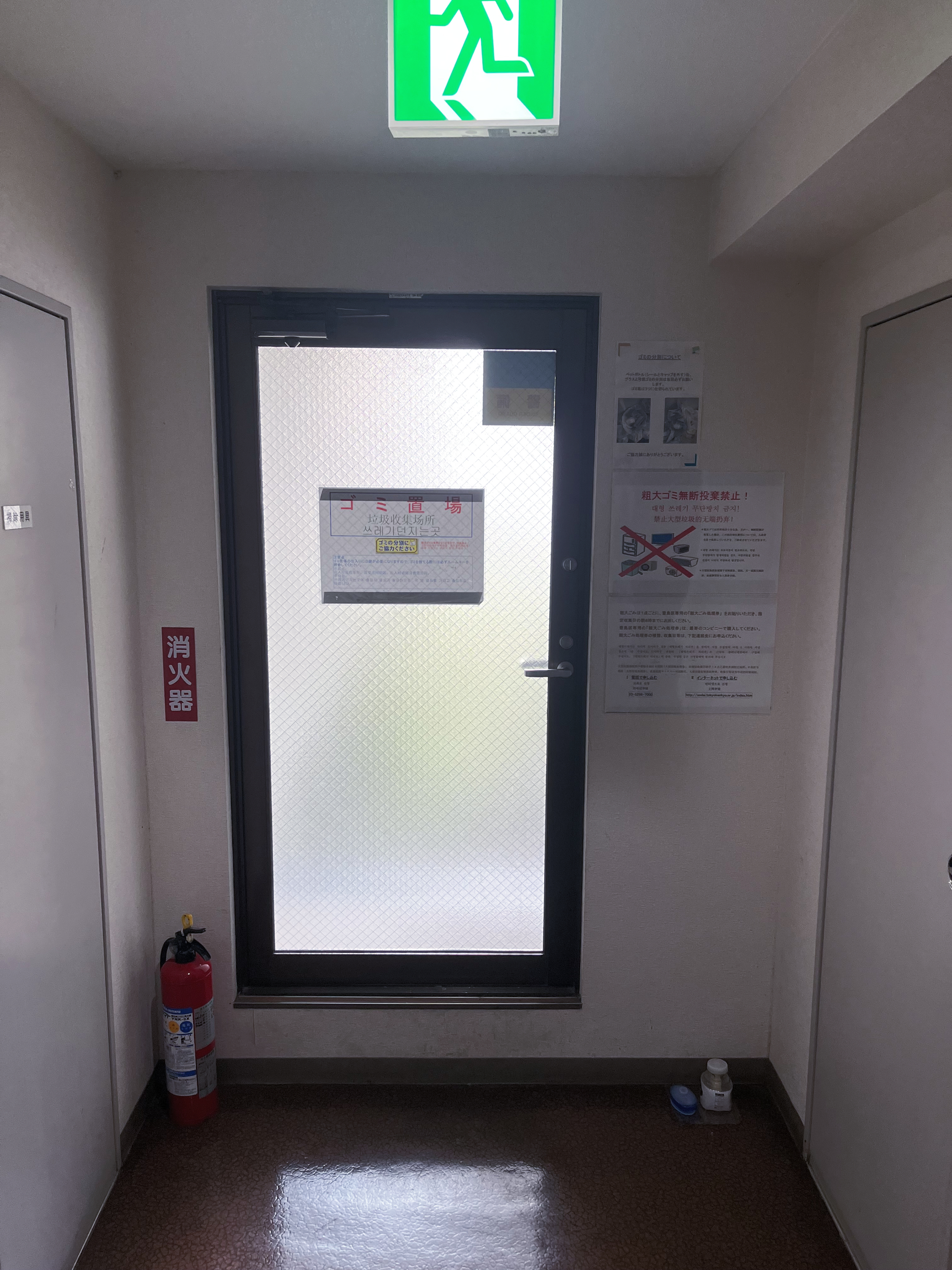
Trash disposal on the first floor, please be careful, the door will lock automatically.
The area is monitored.
Thank you for caring!
 

The password for the House WIFI is advised to you separately.

Cant connect?

Please try to reset the networks on your device:
Example on the iPhone: go to Settings > General > Transfer or Reset iPhone > Reset > Reset Network Settings. This will erase all saved Wi-Fi passwords, cellular settings, and VPN/APN settings, and your iPhone will restart.
You will need to reconnect to Wi-Fi networks and re-pair any Bluetooth devices afterward.

Solution for the portable internet connection:

Short Term SIM Card: https://p.sakuramobile.jp/idevaffiliate.php?id=103_4

Short Term Pocket Wifi: https://p.sakuramobile.jp/idevaffiliate.php?id=103_5

Long Term Stay Sim Card: https://p.sakuramobile.jp/idevaffiliate.php?id=103_12

Long Term Stay Pocket Wifi: https://p.sakuramobile.jp/idevaffiliate.php?id=103_11
Ingredients:
● Pack rice
● Milk (3 tablespoons)
● Bacon
● Shimeji mushrooms
● Salt
● Pepper
● Shredded pizza cheese
 
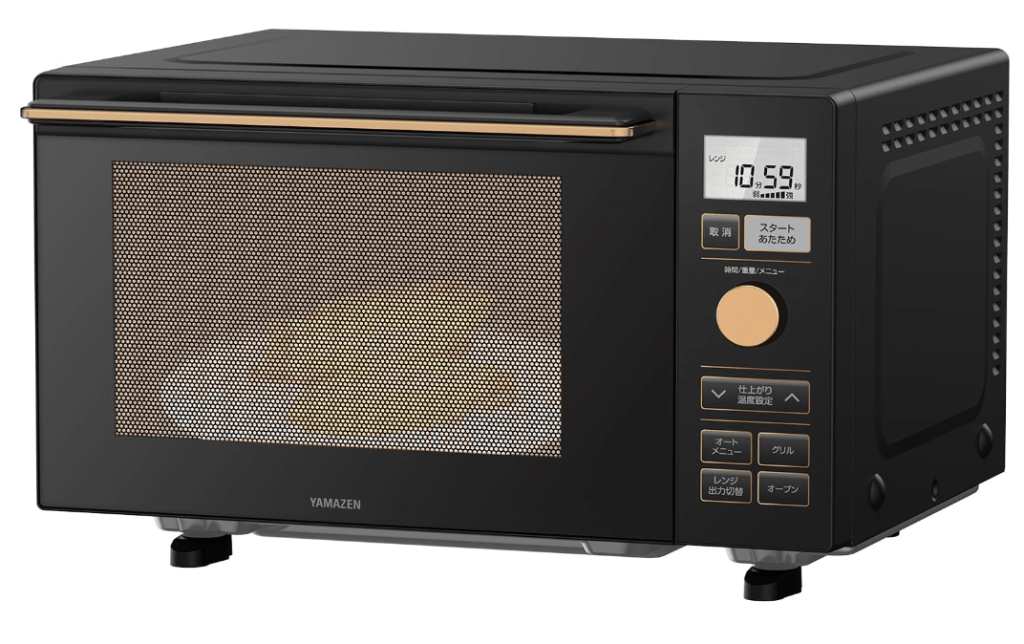
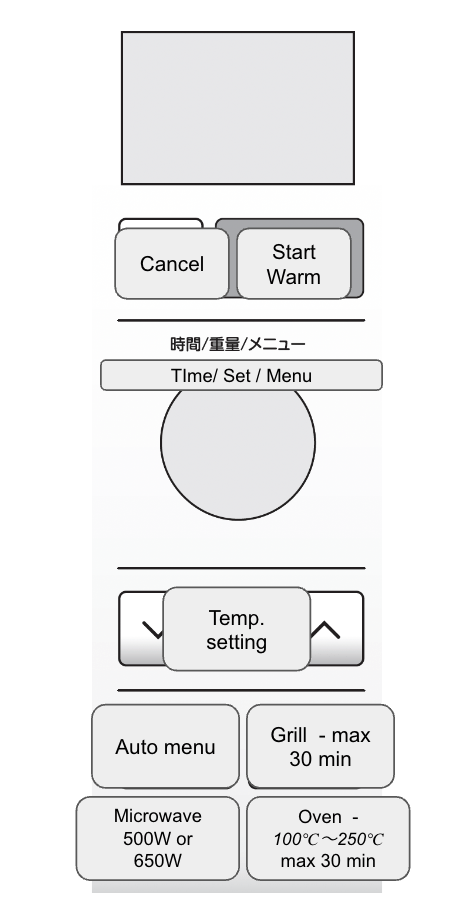
Step 1: Cook the packed rice in the microwave
Step 2: Once the rice is cooked, take the pack out of the microwave and pour the milk over it. Cover the rice with the bacon and shimeji mushrooms, sprinkle on the salt and pepper, and add a layer of cheese over everything.
Step 3: Cover the pack with plastic wrap and put it back in the microwave for one more minute (we set ours to cook at 500 watts).
 
The entire process took just five minutes.

.


Super Convenient Coin Laundry 

Before you go, make sure you have the following items, as having them on hand will make the experience much easier:
A basket or bag to keep your clothes in, Laundry detergent, and plenty of 100 yen coins
 
Going to a coin laundry place can be a little intimidating – after all, you’re visiting a new place with your dirty clothes under your arm, and you’re going to try to use a bunch of machines you’ve never used before. However, it’s not so difficult to make use of these handy establishments, and, like many things, it becomes much easier after you’ve done it once. Here is what you should do when you arrive at your local laundromat.
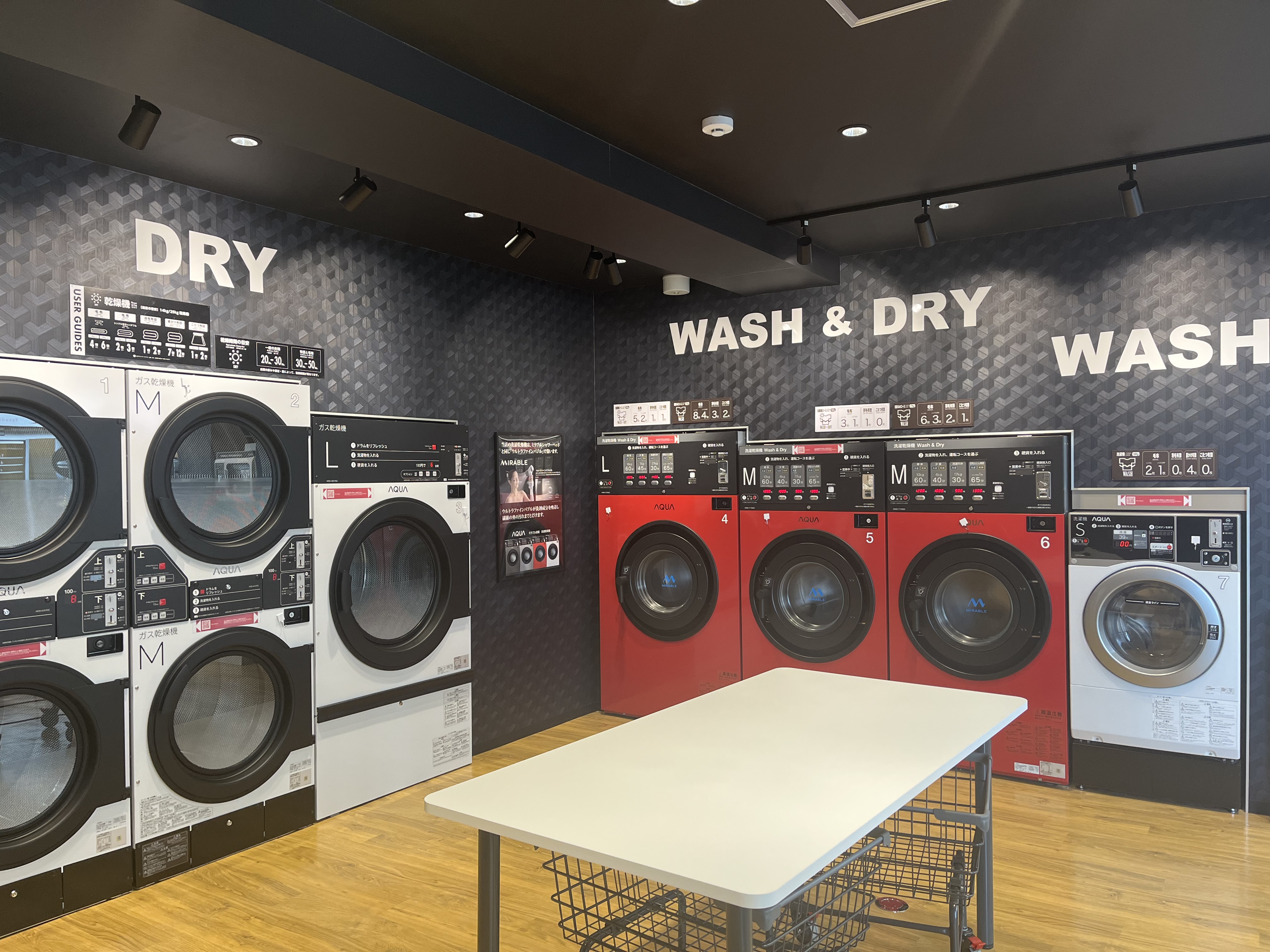
  • Your nearest Coin Laundry In case you missed it on the first floor of the building. 
  • Please use your room key to open the laundry room door.
  • Washing detergent. You can either buy washing detergent at a convenience store/ drug store or buy it from the detergent vending machine in the laundry place (100 yen one pack).
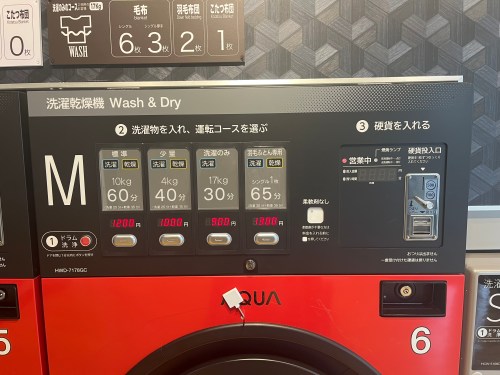
  • Make sure you have the correct change. Both washing and drying machines accept only the 100 yen coins.
  • Put your clothes in the washer. The safest way is to use two machines: one for the white clothes, and one for the rest. After you put all the clothes inside, don’t forget to pour in your washing detergent.
  • Insert the coins. The machine will start as soon as you insert the required number of coins, and then the estimated finishing time will show up. If you are planning to go somewhere else while your laundry is being washed, just put your laundry bag on top of the machine. In some cases, when the machines are all being used, people will take out your laundry and put it inside your bag once it is finished.
  • The dryers are stacked on top of the washing machine and have clear lids. 4.5kg (100 yen for about 30 minutes).
  • Please leave the establishment as clean and tidy as you found it. The coin laundry can be used 24 hours a day.

When the machines are fully in use, and you need to do the laundry?

No worries, here is the best closest laundry mat (1  min walk)

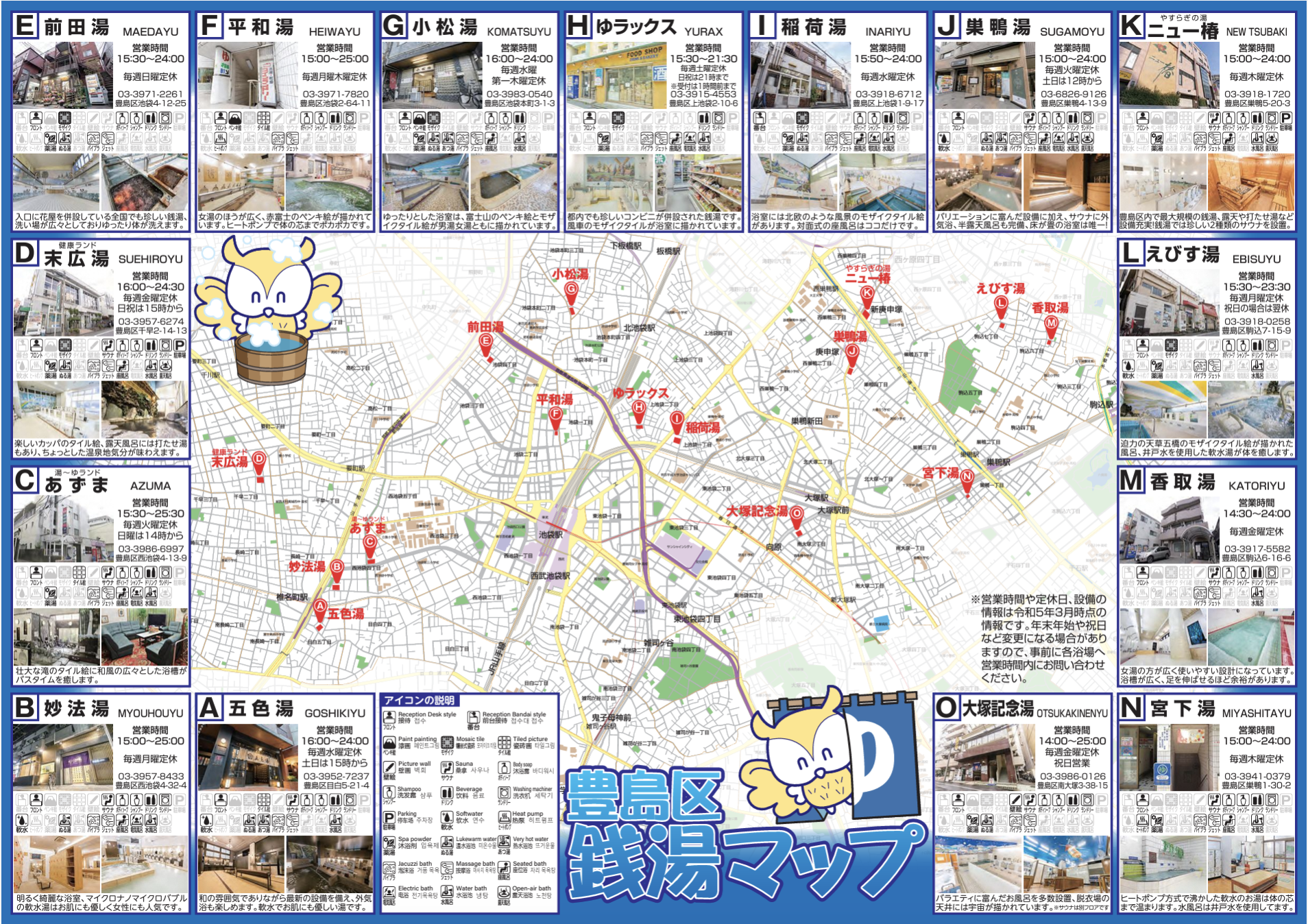
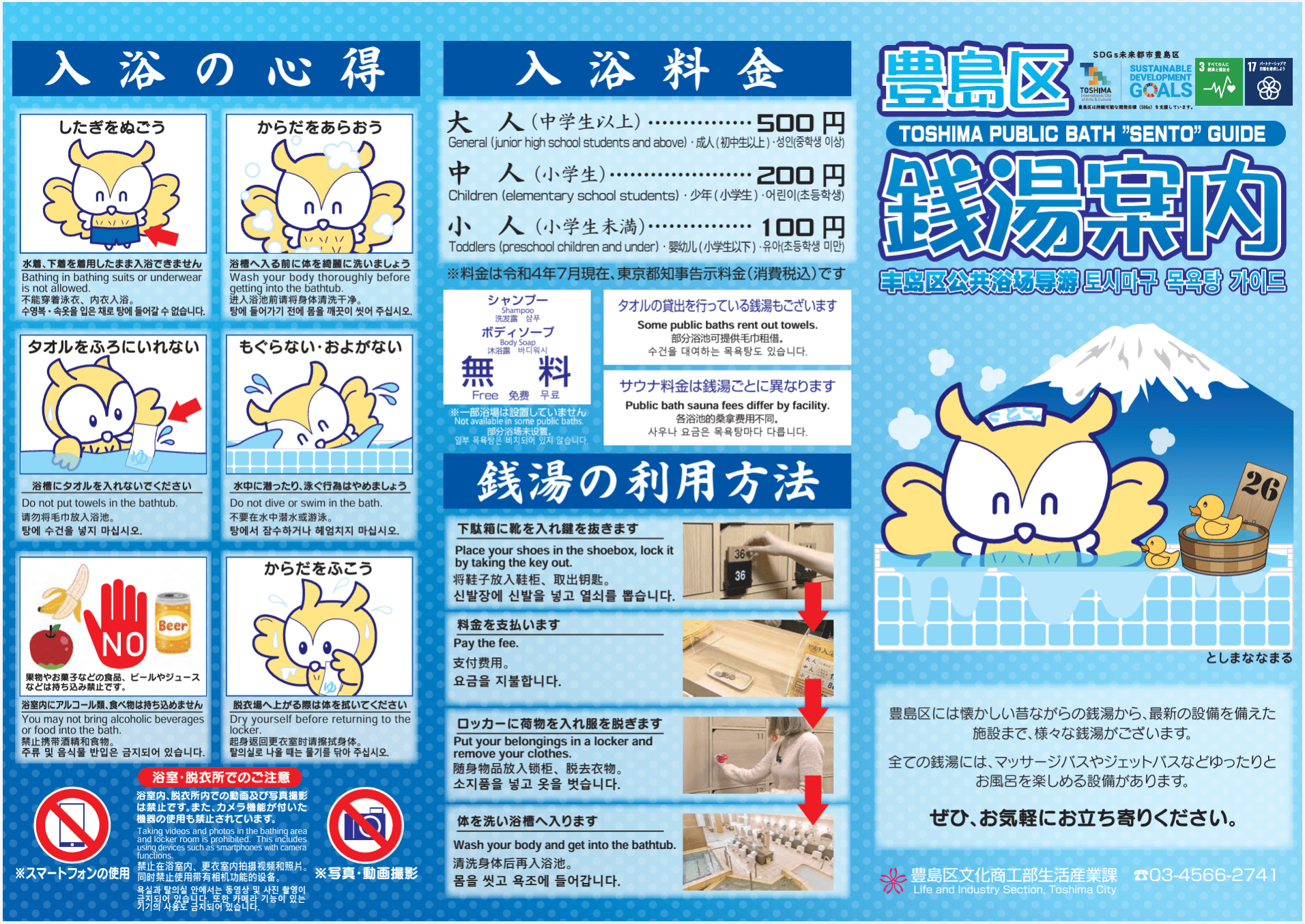
Why not take advantage of the local bathhouse for a bigger bath and an authentic experience?
 
Relaxation and Stress Relief:
The warm, soothing water helps relax muscles, ease tension, and reduce stress. It’s often considered a therapeutic experience.
 
Cultural Experience:
Visiting an onsen or sento is a traditional Japanese practice with deep cultural significance. It allows you to immerse yourself in Japanese customs and practices.
 
Health Benefits:
The minerals in natural hot springs are believed to have various health benefits, such as improving circulation, aiding in detoxification, and alleviating joint pain.
 
Social Interaction:
Bathhouses are communal spaces where people can socialize and connect. It’s common to chat with friends or strangers while enjoying the baths.
 
Ritual and Routine:
The process of bathing, which includes washing thoroughly before entering the communal baths, is a ritual that emphasizes cleanliness and mindfulness.
 
Variety of Baths:
Different types of baths, such as indoor and outdoor baths, cold baths, and jet baths, offer diverse experiences and benefits.
 
Why not take advantage of the local bathhouse for a bigger bath and an authentic experience? Sentō (銭湯) is a type of Japanese communal bathhouse where customers pay for entrance. Here you can find the closest one to the house, Tokyo Somei Onsen Sakura
EBISU-YU えびす湯
KATORI-YU 香取湯
 
Tattoos are still taboo when it comes to sento (communal bathhouse) culture in Japan. While they are seen as an expression of individuality in other parts of the world, Japanese society at large still equates this form of body art with the yakuza. Unless your tattoo is small enough to cover up, chances are you’ll be refused entry — except at these ink-friendly bathhouses.

JNTO (Japan National Tourism Organization) created guidebooks to help foreign people (tourists) who need help during their visit to Japan.

Emergency Numbers for Japan

Police 110

Fire 119

Ambulance 119

Non-urgent Medical #7119

Coast Guard 118

Disaster Safety Confirmation 171

Report Child Abuse 189

Bilingual Support for Travel or Daily-Life Assistancpan https://www.japanhelpline.com/

You can also find useful information about what to do when natural disasters such as earthquakes and tsunamis occur.

Guidebook for when you are feeling ill

日本を安心して旅していただくために

일본을 안심하고 여행하실 수 있도록

讓您的日本之旅更加安心

让您的日本之旅更加安心

View and download digital brochures from JNTO Partners, including those from a variety of prefectures across Japan.

Travel Brochures Japan National Tourism Organization

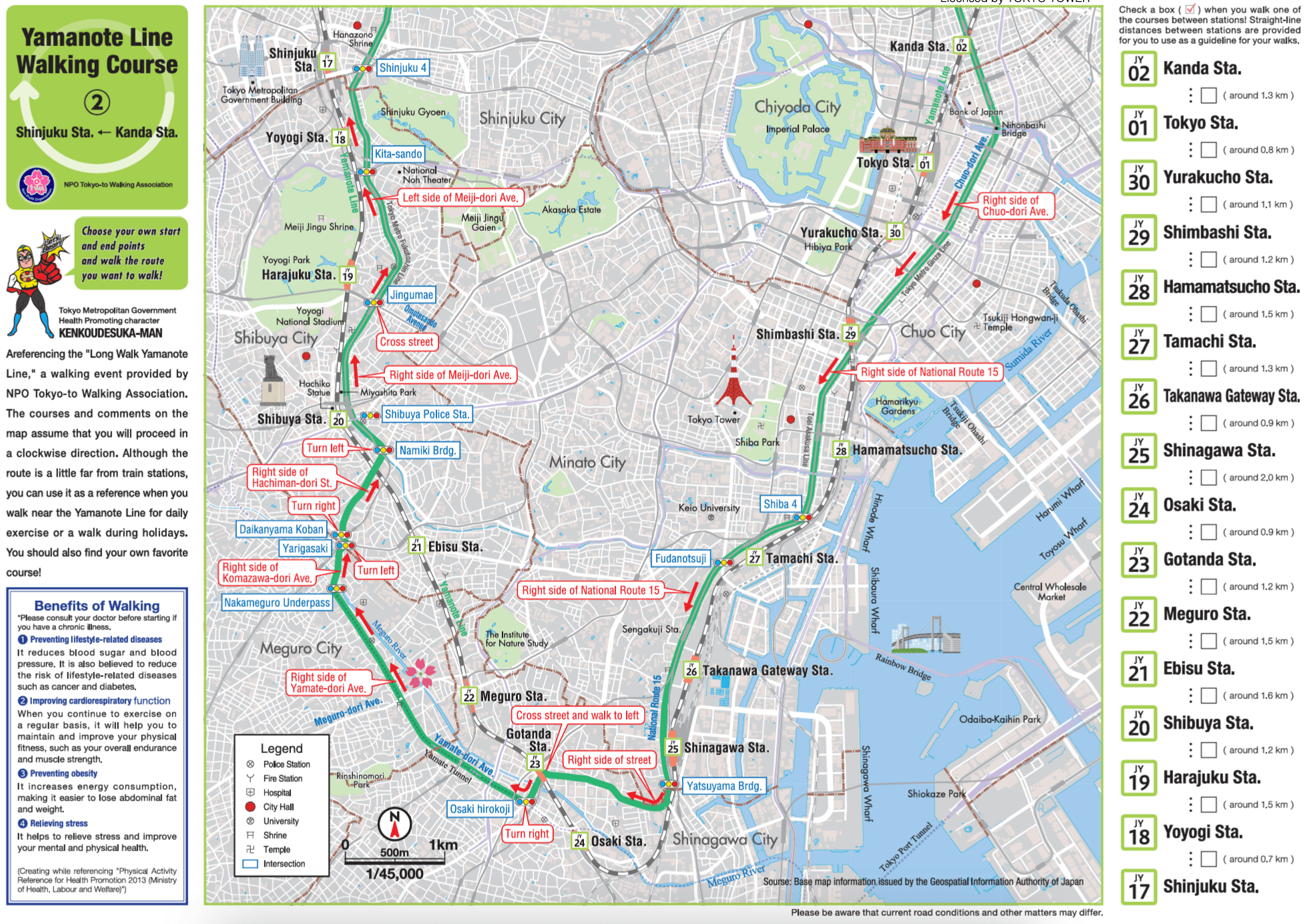
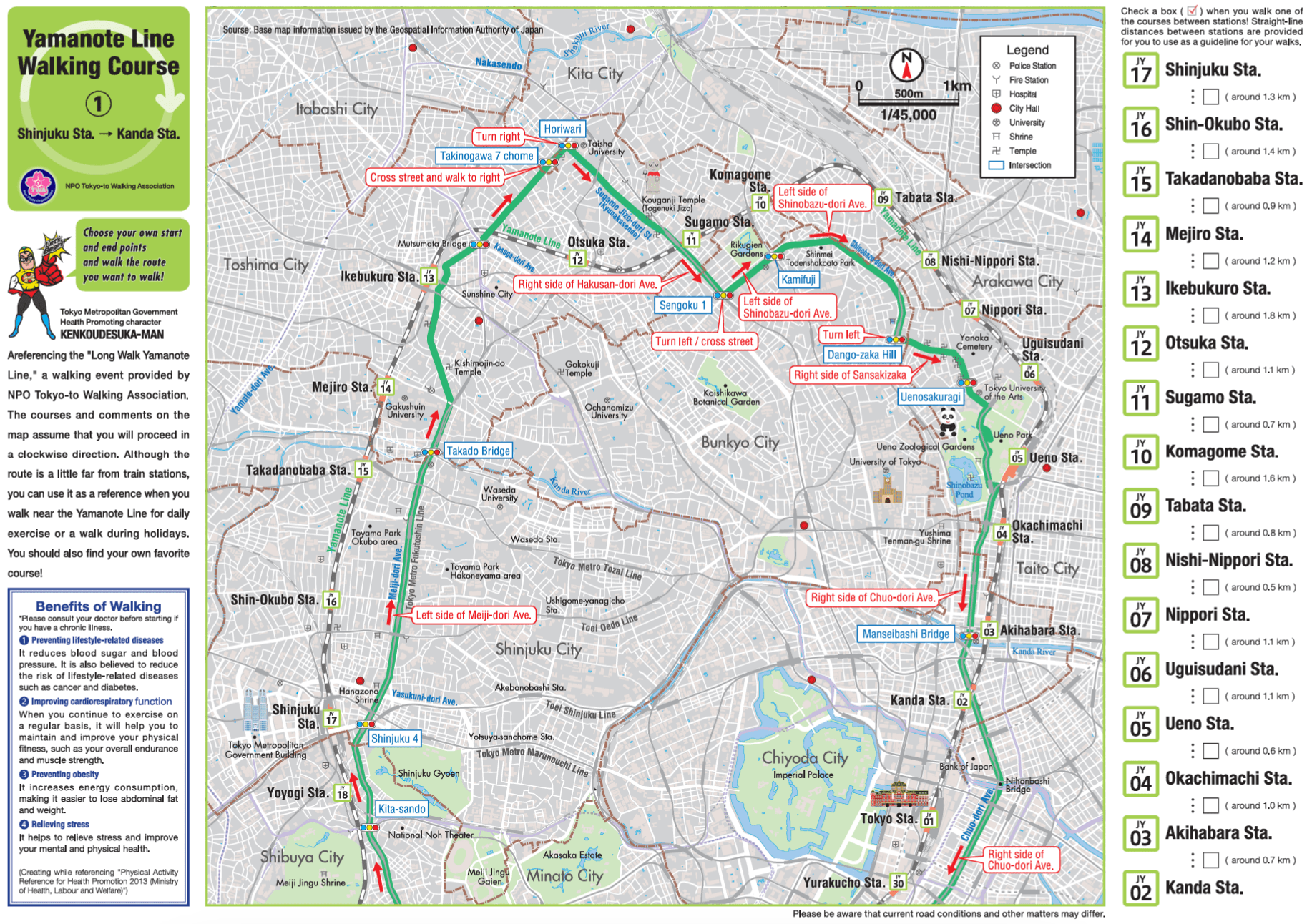
Discovering Tokyo by bicycle is a fun way to explore the city offering

you a wider range of sights and sounds that might otherwise be missed if you are traveling on other forms of public transport. 

Bicycle usage

Make sure you are aware of local laws regarding cycling in the city. As a general rule, keep to the left, keep your speed down, and be aware of pedestrians.

You should use bicycle lanes when they’re available, which are marked with bicycle symbols.

Cyclists are expected to wear a helmet.

Also, make sure to park your bicycle in a designated parking area. If you park anywhere outside of these areas, there is a high chance that your bike will be impounded.

Please cycle safely, following the traffic rules stated on the Tokyo Metropolitan Police Department‘s website.

Tokyo Metropolitan Government ordinance requires all cyclists to be covered by liability insurance.

Bicycle Sharing and Rental

Tokyo Bike Sharing information page (includes a map of bike-sharing stations) https://docomo-cycle.jp/tokyo/?lang=en

Tokyo Rental Bicycle delivers rental bikes to anywhere in the 23 wards of Tokyo! https://tokyo-rental-bicycle.com/

Bicycle tours 

Going on your own Tokyo cycling adventure can be fantastic, but if you want a more curated experience, or you just want to make sure you don’t get lost, the city offers a wide range of guided cycling tours,

including plenty of English-speaking guides.

Some of the options:

Dig Tokyo Tours: https://www.digtokyotours.com/

TOKYO CYCLING AND FOOD TOUR LINE-UP

Dig in and discover the Tokyo small group tour or private outing that’s best suited to your style of travel.

Everyday mamachari cruiser-style bicycles, dashing vintage Japanese road bikes or expedition by foot,

the possibilities are endless as we set off to unravel the sights, sounds, and tastes of Tokyo.

Soshi’s Tokyo Bike Tour: https://www.tokyobiketrip.com/

The most efficient way to see town. It’s on Bike!

Tokyo Great Cycling Tour: Offering great guided tours by bicycle since 2006

Y&Y Cycling Tours: Certified guides take you to some local hidden gems

 
Komagome is often overshadowed by Tokyo’s more famous neighborhoods,
but it offers a unique glimpse into Tokyo’s quieter, more traditional side.
It’s a place where you can still find old wooden houses, traditional craft shops, and a slower pace of life. The area’s rich history, combined with its beautiful gardens and local culture, makes it a delightful area to explore.
 
Things to do in Komagome
Get discount tickets for attractions in Tokyo via Klook (sign up and get an extra 500¥ off) https://www.klook.com/en-AU/invite/3AAU3H?c=JPY
Rikugien Garden
Kyu-Furukawa Gardens
Download guidance on the area in which you are looking to explore
Chinese 按分类、标签查询 https://www.gotokyo.org/book/zh-CN/category_tag/
Korean 카테고리 및 태그로 찾기 https://www.gotokyo.org/book/ko/
 

Komagome – A Community United Under Cherry Blossoms

Komagome is the birthplace of Somei-yoshino, the most popular cherry blossom variety in Japan. We visit a scenic garden, meet locals who cultivate cherry tree saplings, and explore shopping streets. Check out the video 

Click to browse the Area on the Google Map

Rules and Manners

1. Self-check-in; Please come to the apartment by yourself.
We will advise you on the location details and maps. For your convenience, we can arrange the apartment for late-night or early-morning arrivals with an extra charge.
Check-out: please leave the key and the key box as instructed in the messages.
The check-out time is fixed to 11 am; any delay of 15 minutes would
cost 4,000 yen per hour.
Please be ready on time or arrange a late check-out in advance.
2. Please DO NOT lose the apartment key or the pocket WIFI, you will be charged 30,000 yen each.
3. NO SMOKING inside the apartment or on the balcony. Standing and smoking in front of the building entrance is not allowed either. The penalty of 30,000 yen for any disturbance. Thank you for understanding and for not smoking.
4. You must separate the garbage; combustible everyday garbage, recyclables (cans and plastic bottles, and glass), and non-combustible items. You can find enough trash cans and instructions at the apartment.
5. Please use furniture and bedding with care. In the event of damage or staining, please notify us immediately. If furniture, bedding, and fixtures are soiled by vomiting, etc., a flat fee of 50,000 yen will be charged regardless of the reason for the damage.
6. Please DO NOT take home any interior furnishings or equipment (toilet paper, etc.) from the room.
7. Security; Please lock the door when you are in or out, better safe than sorry. Nobody is allowed to enter the apartment other than you, your co-travelers (whom you have told us about), and us.
8. Absolutely no partying and gatherings at the apartment, please respect your neighbors.
9. Please keep in mind that this is a residential complex, not a hotel. Please don’t eat or drink in the common area of the building.
10. Please take your shoes off when you enter someone’s home (including the room of the apartment).
11. Please turn off the air conditioner/ heating while you are not in the apartment; the same applies to other electrical appliances.
12. Japanese people appreciate silence even more than people in their home country might. Please respect that when your check-in is late at night, you behave silently when you are in the entrance/ corridor and elevator area.
【Tips】* If you run into your neighbors, “konnichiwa こんにちは” with a little smile and bow is always a good greeting.
Thank you for choosing our apartment, and we hope you will have a wonderful time while in Japan!
Don’t forget about some manners when you are out of the apartment 🙂
 
Slurp Your Noodles
Making slurping sounds while eating noodles shows that you are really enjoying the meal.
Don’t tip the waiters/ taxi drivers/ shop staff. Tipping in Japan is considered impolite and it will only confuse the people you try to give some extra service. 🙂
 
On escalators, stay on the left side if you plan to just stand and not climb them, except for Osaka, which is the opposite.
 
​Don’t use your chopsticks to point at somebody. Don’t leave your chopsticks standing up out of your food.
 
Thank you!
 

Terms and conditions of use of Komagome Apartments

 
(1) Persons not registered for accommodation must refrain from staying overnight.
Please get in touch for additional guest requests.
(2) Please understand that an extended stay in the Komagome Apartment does not engender legal rights relating to residency.
(3) We may refuse accommodations to minors not accompanied by parents, relatives, or other legal guardians, or unless written permission is received from parents or guardians permitting such stays. We may also refuse accommodation to persons who lack the capacity to reason due to mental impairment or temporary disturbance, or who are deemed to potentially affect the safety and comfort of other residents at the building.
 
2. Apartment Key
(1) When leaving the apartment, please ensure the door is locked.
(2) When checking out of the apartment, and the Manager is not able to meet you, please leave the key in the key box on the door.
 
3. Visitors
(1) Please don’t receive your visitors after 10 pm and during the nighttime.
 
4. At the apartment, please refrain from such activities as described below that may cause a nuisance to other tenants of the building.
(1) Please do not use inflammables for heating, cooking, or the like, such as irons, candles, etc., other than in designated areas.
(2) Please DO NOT SMOKE at the apartment, the penalty is 30,000 yen.
* All rooms are non-smoking (including around the building).
If smoking is confirmed, an extra cleaning fee of 30,000 yen will be charged separately, and you will be evicted without refunds.
Thank you for not smoking!
(3) Please don’t bring dogs, cats, birds, or other animals or other pets into the apartment.
(4) Please do not use the apartment for business activities or private parties, as offices or for any purposes other than accommodation use, without my consent.
(5) Please do not rearrange apartment furnishings or install or remodel the room’s fixtures without my consent.
(6) Please do not remove small furnishings or items from the apartment.
* The minimum damage fee starts from 15,000 yen.
Nights blocked during the repair due to the damage caused might be charged additionally.
(7) Please remove and leave your outdoor footwear near the designated area at the apartment entrance door.

(8) Please do not eat in bed. The penalty for stained bedding and linen is:
¥2,000 per linen item and towel
¥5,000 yen for the comforter, per pillow, bed pad.

(9) Please don’t use the towels provided to take off your makeup or shine your shoes.
(10) Please don’t flush anything other than toilet paper at the toilet.
(11) Please separate the garbage for recycling. Please find the details under “How to separate the trash?”
(12) If you need some extra items (as linen, towels, etc.), please contact me.
(13) Please don’t bring explosives or inflammable substances into the apartment.
(14) Please don’t bring potentially toxic or harmful substances into the apartment.
(15) Please don’t bring into the apartment any other items that possession of which is prohibited by law.
(16) Please refrain from gambling, coercive speech or conduct, behavior corrupting public morals, or behavior, speech, or conduct (including loud noises) that other tenants may find abhorrent, or that may cause a nuisance to other tenants.
(17) Please refrain from the distribution of advertising or publicity literature, sales of goods, soliciting, or other such activity within the apartment.
 
5. Unclaimed articles
Unclaimed articles, unless otherwise specified, shall be held for the periods detailed below. Articles that remain unclaimed after those periods shall be treated, in accordance with the law, as items the owner has no interest in receiving.Items left in the apartment: 1 week from the vacating date.
All unassigned property will be forwarded to a charity or disposed of, depending on value. If we send articles back to the guest, we will charge a postage and packaging fee separately.
 
6. Please cooperate with economies of electricity and water for the preservation of natural resources.
Please turn off all the lights and air conditioners when leaving the apartment.
 
7. Losses, Liabilities, etc.
(1) Guests must report any loss or damage to their property immediately on discovery and shall make themselves available to assist with any reports made by the Manager to the police.
(2) Guests shall not enter areas of the building that are indicated as being closed to the public. The Manager shall not be responsible for death, personal injury, loss, or damage to property suffered by a guest in such areas.
(3) The Manager shall not be liable to a guest for any loss or damage to property caused by the misconduct or Negligence of a guest or an Act of God, or where the guest remains in exclusive charge of the property concerned.
(4) The Manager shall not be liable for any failure or delay in performing any of its obligations under this Agreement if the failure or delay was due to any cause beyond its reasonable control, including (without limitation) war or threat of war, civil or political action or disturbance, riot, natural disaster, fire, epidemic, bad weather, terrorist activity (threatened or actual), military activity, governmental or regulatory action, industrial dispute, act of God, failure of power or machinery, failure of or interruption in externally provided services and utilities, and all similar events outside the Manager’s control.
(5) The Manager is not liable for any loss or damage caused to a guest’s vehicle unless caused by the Manager’s willful misconduct.
(6) Guests will be liable for any loss, damage, or personal injury they may cause at the apartment.
(7) The guest is liable for any damage to the apartment and its equipment during his/her stay at the apartment. If the guest damages any room or its equipment or makes the room or its equipment dirty in a non-standard way, the Manager reserves the right to fine such a guest in the amount of 50,000 yen, unless the damage is proven in a higher amount.
 
Thank you!
Scroll to Top